
 Track Order
 Wishlist
 Sign In

 FREE delivery over £500*
 Visit our showrooms
 Finance options available*
 Apply for a Trade Account
Bowel and Bladder Cancer Symptoms: Why 1 in 4 Brits Are Ignoring the Warning Signs
17th Mar 2026

The time we spend in the bathroom can give us some of the biggest clues about our internal health. Several medical conditions, including bowel and bladder cancer, can show themselves through subtle changes when we go to the toilet.
Despite this, people across the UK admit to ignoring these warning signs due to a mix of embarrassment, fear, or a misplaced sense of guilt about wasting a doctor's time.
With Bowel Cancer Awareness Month being marked in April, we want to help break the stigma. We’ve carried out a survey of 2,000 UK adults (male and female) and partnered with Dr Alia Fahmy to uncover what the British public knows about toilet health, where the delays in seeking help happen, and what symptoms doctors want you to look out for.
Contents
- How much do we pay attention to our toilet habits?
- The awareness vs action gap
- What people recognise (and what they miss)
- How urgently are Brits seeking medical help?
- Why are people delaying seeing a GP?
- Dr Google vs medical advice
- Methodology
How much do we pay attention to our toilet habits?
Monitoring your health starts with a simple look before you flush. Our survey revealed a range of habits when it comes to how often Brits are actually checking for changes:
- 53% said they always check
- 43% sometimes monitor their toilet habits
- 4% told us they never check
While it's great to see that over half of the population are keeping an eye on things, the fact that over 43% only check sometimes is a concern. Consistency is the most important factor when it comes to spotting the early symptoms of bowel cancer or bladder issues.
If you only check occasionally, it's much harder to know what your 'normal' looks like, meaning a gradual change in colour or consistency could easily be missed.
The awareness vs action gap
There's a fairly big disconnect between what we know and what we do when it comes to our health. Our survey found that, while 85% of people say they're aware that toilet changes can signal cancer, over half (51%) admit they've put off seeking medical advice when unsure about a symptom.
Even more concerning is that almost 1 in 4 (23%) of those who previously noticed a worrying change in their bathroom habits didn't seek any medical advice at all. This suggests that increasing cancer symptom awareness isn't enough on its own to stop people from delaying a GP visit.
Dr Fahmy explains why this gap exists:
"As a GP, I find that gap between awareness and action troubling, but sadly, not surprising. Campaigns have rightly emphasised 'red flag' symptoms such as blood where it shouldn't be, unexplained weight loss, and persistent changes in bowel habits, yet knowing something in theory does not automatically translate into doing something about it in practice."
The delay in getting help from a professional is usually rooted in complex feelings of fear and denial, rather than a lack of information. As Dr Fahmy continues:
"The reasons are rarely about ignorance. They are about emotion and fear. For some, there is an unspoken belief that if you don't investigate a symptom, it cannot become real. Others minimise what they notice, putting their symptoms down to other causes such as haemorrhoids or stress. There is also a psychological phenomenon known as optimism bias, where we instinctively believe serious illness happens to other people."
"Many people also feel guilty about adding pressure to an already stretched health service and worry about wasting the doctor's time."
This emotional hesitation is a major hurdle, as it creates a critical window where opportunities for early detection and treatment can unfortunately be lost.
What people recognise (and what they miss)
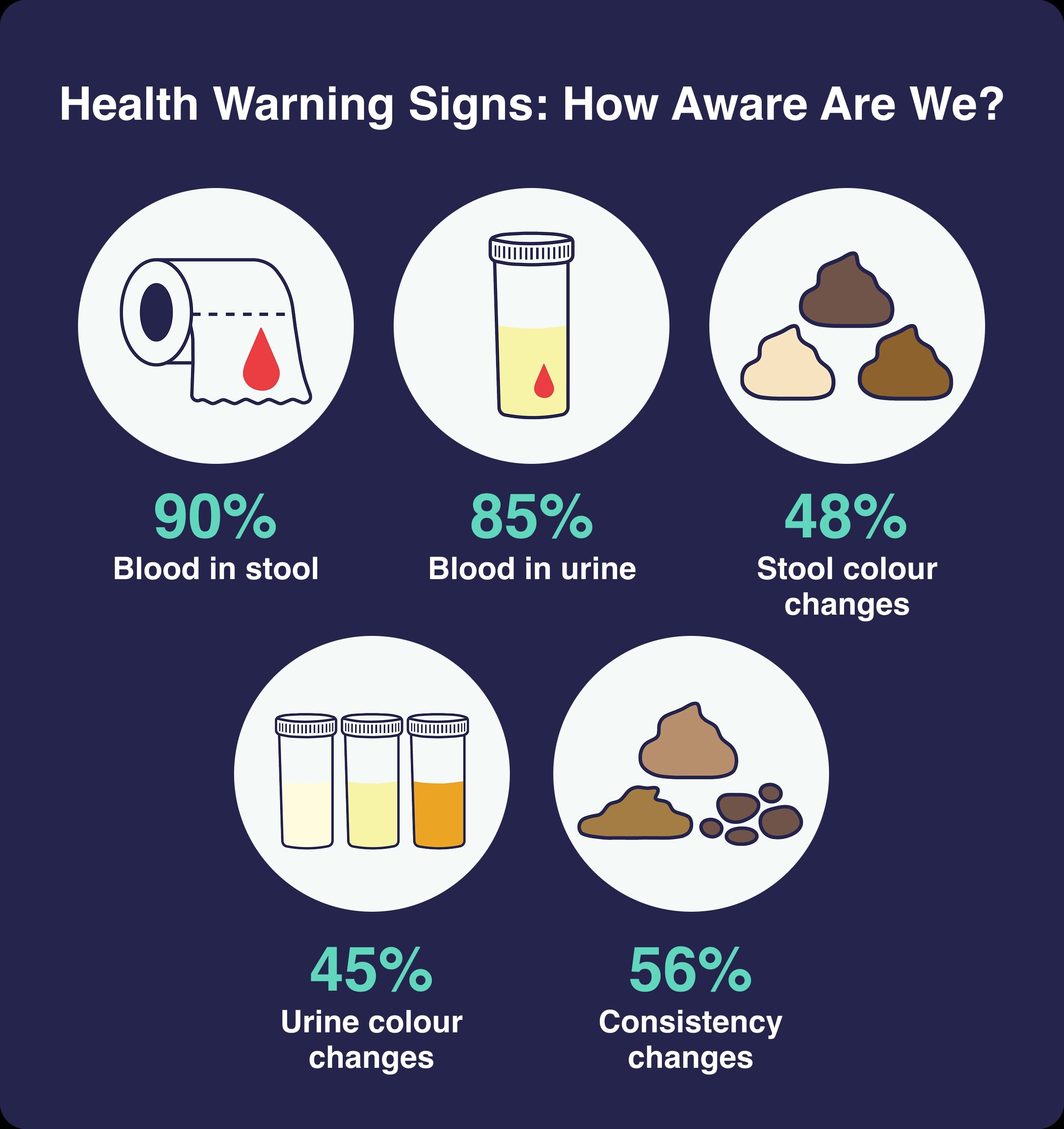
While most people are quick to spot any dramatic changes while using the toilet, the more subtle symptoms of bowel or bladder cancers tend to be overlooked.
Our research showed a high awareness of blood in the stool (90%) and urine (85%) as red flags to be wary of. However, this awareness drops significantly when it comes to other, smaller changes. For example:
- Only 48% recognise stool colour changes as a warning sign
- Just 45% are aware of the significance of urine colour changes
- Slightly over half (56%) realise that changes in consistency matter
This lack of detailed knowledge is reflected in respondents' confidence in spotting warning signs: only 19% said they felt ‘very confident’ in recognising symptoms, while 29% were actually sure they knew what a ‘healthy’ stool or urine should look like.
In fact, 63% of people believe there simply isn't enough awareness regarding the early signs that are detectable through toilet habits.
To help clarify, Dr Fahmy outlines what a healthy baseline looks like:
"These details matter. A healthy stool is typically brown, soft but formed, and passed without significant straining, often described clinically using the Bristol Stool Chart as types three or four."
So, what should we be on the lookout for?
"Persistent diarrhoea, new constipation, pencil-thin stools, black tarry stool, pale clay-coloured stool, or mucus mixed with stool all warrant attention, particularly if new and sustained. In individuals over forty, a change in bowel habit that does not settle should always be discussed with a GP," Dr Fahmy says.
"Healthy urine, meanwhile, is pale straw to light yellow and clear. Red, pink or cola-coloured urine, even if painless, must be investigated. Persistent cloudiness with symptoms, dark brown urine, or unexplained foamy urine can also signal underlying issues. The absence of pain does not equal the absence of significance."
How urgently are Brits seeking medical help?
When you notice something isn't quite right, timing is everything. However, our survey revealed that many of us are delaying or even avoiding seeing a GP after spotting a change. We asked how long after spotting a change people went to a medical professional, and the results were:
- Within 1 week – 35%
- 1-2 weeks – 16%
- Immediately (within 24 hours) – 14%
- More than 2 weeks – 11%
- I did not seek medical advice — 23%
It's important to act quickly if you spot a red flag. Some health conditions, including certain types of cancer, can develop rapidly. Even a few weeks' delay can affect how successful your treatment might be.
While it's tempting to wait and hope a symptom clears up on its own, it's always better to get a professional opinion as soon as possible to give yourself the widest range of treatment options available.
Why are people delaying seeing a GP?
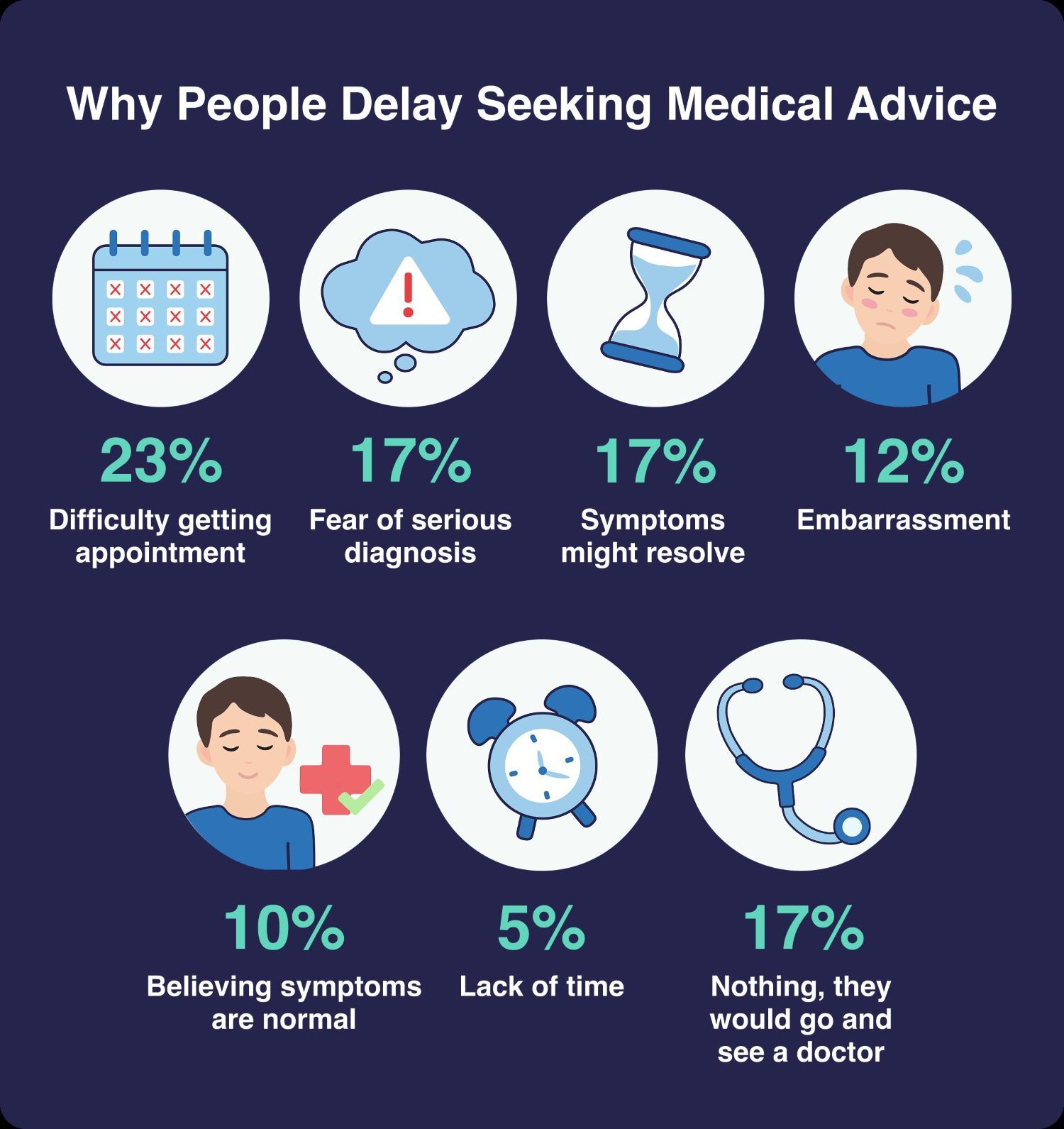
Understanding the barriers that are stopping people from seeking help is vital for improving bowel and bladder cancer awareness. Our survey highlighted several reasons why people avoid booking that expert appointment:
- 23% cited difficulty getting a GP appointment
- 17% admitted to a fear of a serious diagnosis
- 17% hoped the symptoms might resolve on their own
- 12% felt embarrassed speaking about their symptoms
- 10% believed their symptoms were actually normal
- 5% said a lack of time
Only 17% of respondents said nothing would stop them from seeing a doctor immediately.
Dr Fahmy explains that waiting for a symptom to become severe can be a mistake:
"Ultimately, there is an issue with the emotional space between noticing something and acting on it. That pause, driven by fear, embarrassment or hope that it will disappear, is where delay happens."
"The difficulty is that early cancer symptoms are often subtle. They do not usually arrive dramatically but instead creep in quietly and surreptitiously: a change in consistency, a shift in colour, a slightly altered pattern. Early presentation can be the difference between straightforward treatment and complex intervention."
"As a general rule, any persistent change lasting more than three weeks should be assessed. Visible blood in stool or urine warrants medical advice even if it happens only once. Unexplained weight loss, new fatigue, or a sustained alteration in bowel habit should not be ignored. You do not need to wait for symptoms to become severe before seeking help. In fact, waiting for severity is precisely what reduces options."
"Embarrassment still surrounds bowel and bladder symptoms; we are far more comfortable discussing headaches than stools. The conversation you fear having may be the one that protects your future. If something changes and does not settle, speak to your GP. You are not overreacting. You are being sensible."
Dr Google vs medical advice
In the digital age, many of us turn to the internet for a quick answer before speaking to a professional. While digital spaces can be a great way to share the emotional burden and talk to others with similar symptoms, our survey revealed a worrying reliance on online platforms:
- 52% said they would look online for information first
- 29% would book a GP appointment
- 9% ask a friend or family member
- 6% contact a pharmacist
- 4% would do nothing and 'wait and see' if symptoms improve
While the internet can offer reassurance, it's also a breeding ground for misinformation, as Dr Fahmy warns:
"The internet can empower patients with knowledge, reduce embarrassment, and prompt earlier presentation. However, it also carries risk. Misinformation is widespread. Online searches can either falsely reassure or catastrophise. Anecdotal forums can distort perspective. A search engine cannot examine you, interpret subtle clinical nuances, or consider your full medical history. If people do look online, reputable sources such as the NHS website or Cancer Research UK are far safer starting points."
"For those worried about appointment access, alternatives do exist. Community pharmacists provide excellent frontline triage. NHS 111 offers advice, and many practices offer online consultation systems. Practice nurses and urgent treatment centres can assess certain symptoms. Screening programmes, such as bowel cancer FIT testing and cervical screening, are also vital safety nets. But if a symptom persists or feels out of character for you, GP assessment remains important."
While only 4% said they would do nothing, the 'wait and see' approach can potentially have life-altering consequences. Dr Fahmy adds:
"The 'wait and see' approach has its place in medicine - many minor illnesses resolve on their own. But when it comes to potential cancer symptoms, delay carries risk, as disease can progress and treatment options may narrow. Plus, interventions can become more invasive, and anxiety often grows in the background. By the time symptoms become impossible to ignore, the clinical picture may be more advanced."
Breaking the taboo around toilet health
Normalising the conversation around our toilet habits is one of the most effective ways to encourage people to take early action. We shouldn't feel judged or embarrassed by the way our bodies function; instead, we should feel empowered to monitor our health and speak up when something doesn't feel right.
Early detection saves lives. Whether it's a change in colour, consistency, or frequency, your body is often trying to tell you something. By paying attention to these signals and overcoming the urge to delay, you're taking a vital step in protecting your future.
Methodology
We commissioned a nationwide, anonymous survey of 2,000 UK adults aged 18 to 75 (male and female) to explore:
- How often people check for changes in their toilet habits
- How confident they feel identifying warning signs
- Whether they delay seeking medical advice
- Why people hesitate to contact a GP
- Where they turn for information first
The survey was conducted in February 2026, and figures have been rounded for ease of reading.
To interpret the survey findings, we partnered with Dr Alia Fahmy, who provided expert insight on what symptoms people often misunderstand and when they should seek medical advice.